A charger that travels with the vehicle is convenient, but it also needs a suitable place to live. An external charger avoids taking up vehicle space, yet someone has to store it, carry it and keep it available. Choose the arrangement after matching the battery voltage, capacity and charging limits. Installation convenience cannot compensate for the wrong electrical configuration.
Where will the charger spend its working life?
An on-board battery charger is installed on the vehicle. An off-board battery charger remains external during charging. These terms describe the arrangement, not the charging speed or battery chemistry. A product with a handle is not automatically approved for every portable use, and mounting tabs alone do not establish suitability for permanent installation.
For high-speed electric motorcycles, our common enquiries include 60V/20A and 48V/35A. Golf cart requests commonly include 36V/18A and 48V/15A. First identify the installed battery and the correct charging profile. Then decide which physical arrangement fits the vehicle and how its owner will charge it.
Compare the practical work, not just the purchase price
| Question | On-board arrangement | Off-board arrangement |
|---|---|---|
| Where is the space? | Needs an approved mounting location on the vehicle | Needs a suitable charging and storage location |
| What moves each day? | Charger moves with the vehicle | Staff or rider may need to carry or position it |
| What exposure matters? | Vehicle vibration, heat, dirt and weather conditions | Handling, storage and charging-location conditions |
| How is service performed? | Access and removal need planning | Unit may be easier to exchange, subject to its design |
| Can chargers be shared? | Usually tied to the installed configuration | Sharing requires verified battery and interface compatibility |
Consider the daily routine. A rider who charges at several permitted locations may value having the charger with the motorcycle. A resort with a fixed charging area may prefer external units that staff can inspect and manage. These are reasons to evaluate an arrangement, not promises that a particular series supports it.
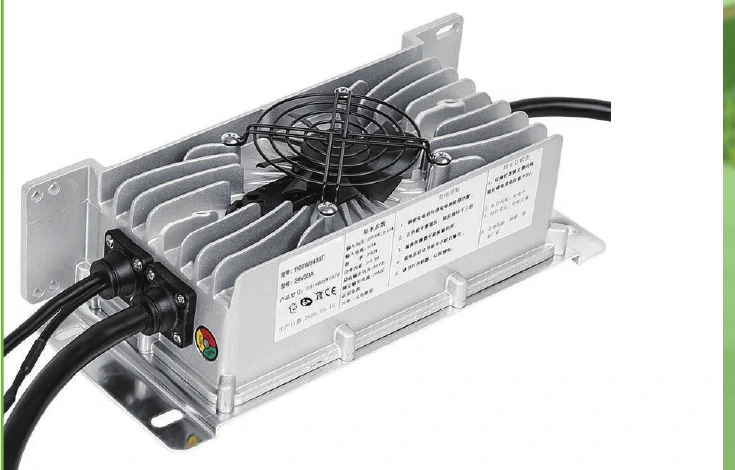
For an on-board charger, request a mounting drawing early
Send the available space, mounting surface and cable route before ordering a sample. Ask for the exact dimensions, weight, orientation restrictions, fixing requirements and cooling clearances. Do not estimate fit from a product photo. Leave service access in the discussion: a unit that fits only before other vehicle components are assembled may be awkward to replace later.
Specify the surrounding temperature and exposure during both driving and charging. A location close to another heat source can change the installation requirement. The manufacturer should state the permitted conditions and any output derating. A waterproof enclosure claim does not make connectors, cable joints or an unsuitable mounting location acceptable.
Vehicle integration also includes controls. Ask whether charging requires an enable signal, drive interlock or BMS communication. The controls must work with the actual vehicle. Do not add or bypass a connection from a generic illustration.
For an external charger, plan handling and identification
Think about where staff will put the unit while charging and after use. Ask for handling instructions, cable-storage guidance and the permitted charging environment. A carry handle helps show the physical form, but it does not prove that the charger can be operated in a closed bag or left exposed outdoors.
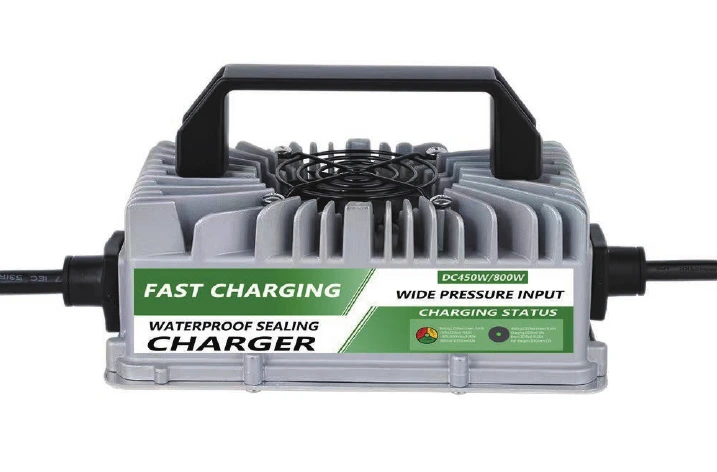
If several vehicles use similar-looking plugs, label the approved charger-to-battery combinations clearly. Separate voltage families and battery chemistries. Sharing an external unit between vehicles should be a verified operating decision, not something staff infer because the plug fits.
For a dealer, also consider what the customer receives: the charger, approved cord and connector, instructions and an identifiable configuration label. A missing or ambiguous label can turn a straightforward replacement request into a lengthy after-sales exchange.
Test the arrangement you intend to sell
Agree a sample review using the real battery and intended installation. Confirm electrical matching first, then assess access, routing, controls and the manufacturer's thermal requirements. A bench demonstration does not verify a permanent vehicle installation. Electrical and installation work should be performed by qualified personnel using the battery and vehicle instructions.
Record the accepted mounting arrangement and charger revision. When comparing two quotations for an off-highway battery charger, ask whether each includes the same input version, profile, connector and installation scope. Otherwise, a lower price may describe a different solution.
What to send for a recommendation
Send battery nominal voltage, capacity in Ah, chemistry, permitted charge limits, vehicle model, intended arrangement, AC supply and interface details. Include photos of the proposed location if considering on-board installation.
Start with the industrial charger enquiry page, or review the motorcycle battery selection guide. Current industrial-line terms are MOQ 30 units, branding labels from 200 units subject to artwork confirmation, and approximately 15-30 days production depending on quantity and customization. Confirm the configuration and schedule in the quotation; shipping is additional.
Questions buyers ask
Is an external charger slower?
Not because it is external. Compare the actual output, charge profile and battery requirements, including the available current at the intended AC supply.
Can a portable charger be permanently mounted?
Only if the manufacturer approves that configuration and installation. A handle or convenient dimensions are not sufficient evidence.
Can one external charger serve a whole fleet?
Only where the battery, profile, interface and controls have been verified for every approved combination. Keep mixed voltage and chemistry groups separate.
Request a charger configuration review
Send the battery voltage, capacity in Ah, chemistry, charging limits, AC supply and interface details.
Send your requirements