Connector ends
Confirm Type 2 on the charging-station side and Type 2 on the vehicle side.
Source a Type 2 EV charger cable with a Type 2 connector at both ends for compatible AC charging stations and vehicles. Specify phase, current, length, cable construction and intended market as separate order fields.
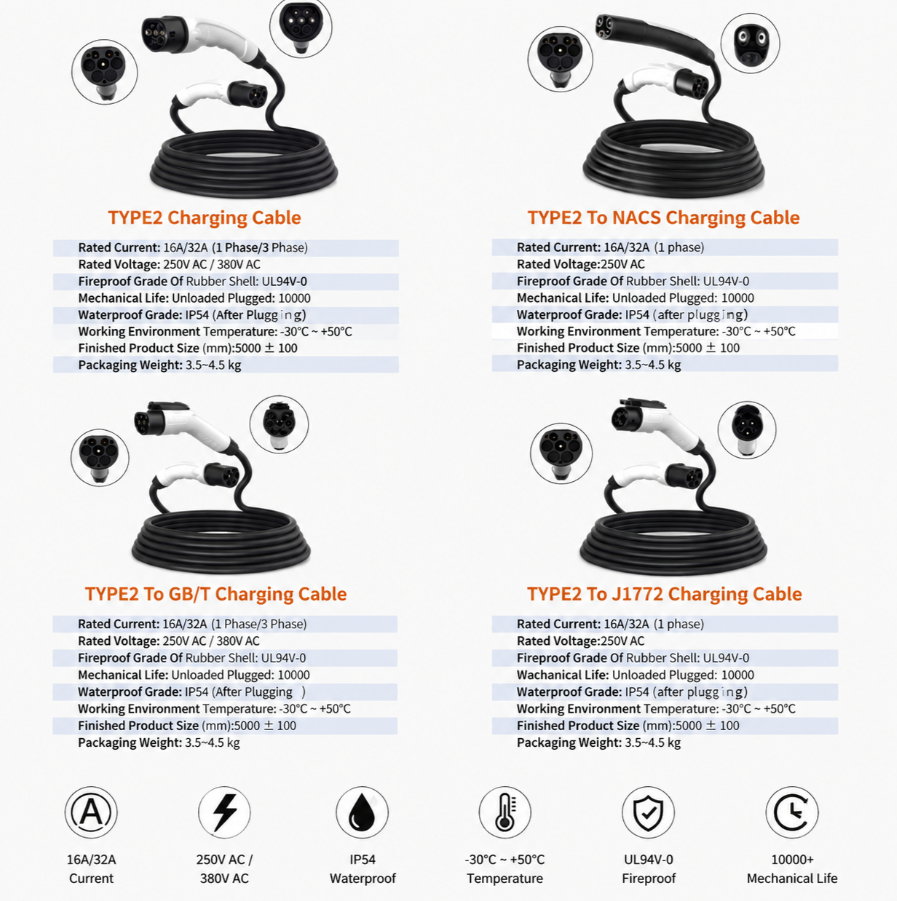
A Type 2 to Type 2 charging cable—also searched as an EVSE Type 2 cable, Type 2 EV charger cable or EV charging cable Type 2 to Type 2—is a detachable AC cable without a portable charger control box or mains input plug. This page serves cable buyers only.
Confirm Type 2 on the charging-station side and Type 2 on the vehicle side.
Separate single-phase and three-phase variants; confirm current and voltage for the exact cable.
Choose length from parking layout, routing and storage needs rather than keyword popularity.
A search for a “Type 2 to Type 2 cable 22kW 32A three phase” describes a target configuration, not universal availability. Confirm the exact model, voltage, conductor construction, length and test evidence before ordering.
No. A detachable Type 2 to Type 2 cable has connector ends for the station and vehicle; a tethered assembly has an equipment-side termination.
No. Phase, current, conductor construction, vehicle and charging station conditions must match the exact cable model.
Required length is an RFQ field, not a universal availability claim. Send the target length, current, phase, quantity and market so the exact model and current availability can be confirmed.
No. “32A Type 2 charging cable” does not fully define the cable. Confirm phase, voltage, connector ends, conductor construction and model-specific rating.
Create a length-specific product page only after that length is a real, orderable variant with its own model data, imagery, packing and validation evidence.
Send phase, current, length, quantity, target market and packaging needs.
Request a cable matrixA 32A Type 2 to Type 2 charging cable connects a compatible socketed AC station to a Type 2 vehicle inlet. Current alone does not define power: supply voltage, phase, station limits and the vehicle's onboard charger all matter. A passive cable cannot increase the power that the station or vehicle accepts.
At a nominal 230V and 32A, the theoretical electrical power is about 7.4kW. Actual charging power depends on the equipment and operating conditions.
At a nominal 400V line-to-line and 32A, balanced three-phase electrical power is about 22kW. This requires a compatible three-phase supply, station, cable and vehicle; it is not a universal cable capability.
Ask for the exact part number, phase, rated voltage/current, conductor specification, length, drawing and applicable market documentation.
Current selection and supply limits · Cable vs portable EVSE · OEM and wholesale cable sourcing